

The Flight From Bannockburn

Now that the English, including their king, were in full rout, they were pursued by the Scottish forces, the infantry cutting down any they could catch on foot and Keith’s light horse, joined by Douglas racing after the fleeing English king and his party. Any knights who were captured trying to escape were taken prisoner: they would be worth ransoming.
The Fate of Edward II
Edward II, once free of immediate danger, rode hard towards Stirling with a troop of some of his household cavalry (including Hugh Despenser the elder and Henry de Beaumont) – those who had been lucky enough to escape the deadly pikes of the schiltrons. Coming to Stirling Castle he found the drawbridge raised and the gates shut firm against him. Mowbray told him that if he entered the castle, it would soon be besieged by the Scots and there would be no-one from England who would be able to come and save him from eventual capture. Instead he urged Edward to flee back towards the Tor Wood.
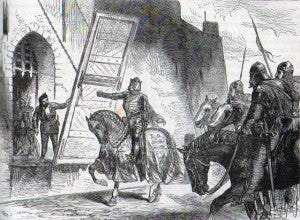
Edward and most of his men did so, although some stayed behind at the rock and it was these that Bruce sent a large force after, for he did not want any stray English men to attack him from the rear. He also ordered Douglas to take 60 horse and go after Edward as best as he could. By now, Edward and his men had reached the other side of Tor Wood and were headed for Linlithgow. They stopped only long enough to feed their horses, and then, seeing Douglas gaining on them, sped off.
Douglas’s men were actually not much of a threat, as they were heavily outnumbered by the English surrounding Edward, but even so, after being so humiliated on the field, it was probably thought better to get the king away then stand and fight. Both horses and men were exhausted and demoralised. The king’s own horse had been badly wounded, and during the chase he had to remount on a courser.
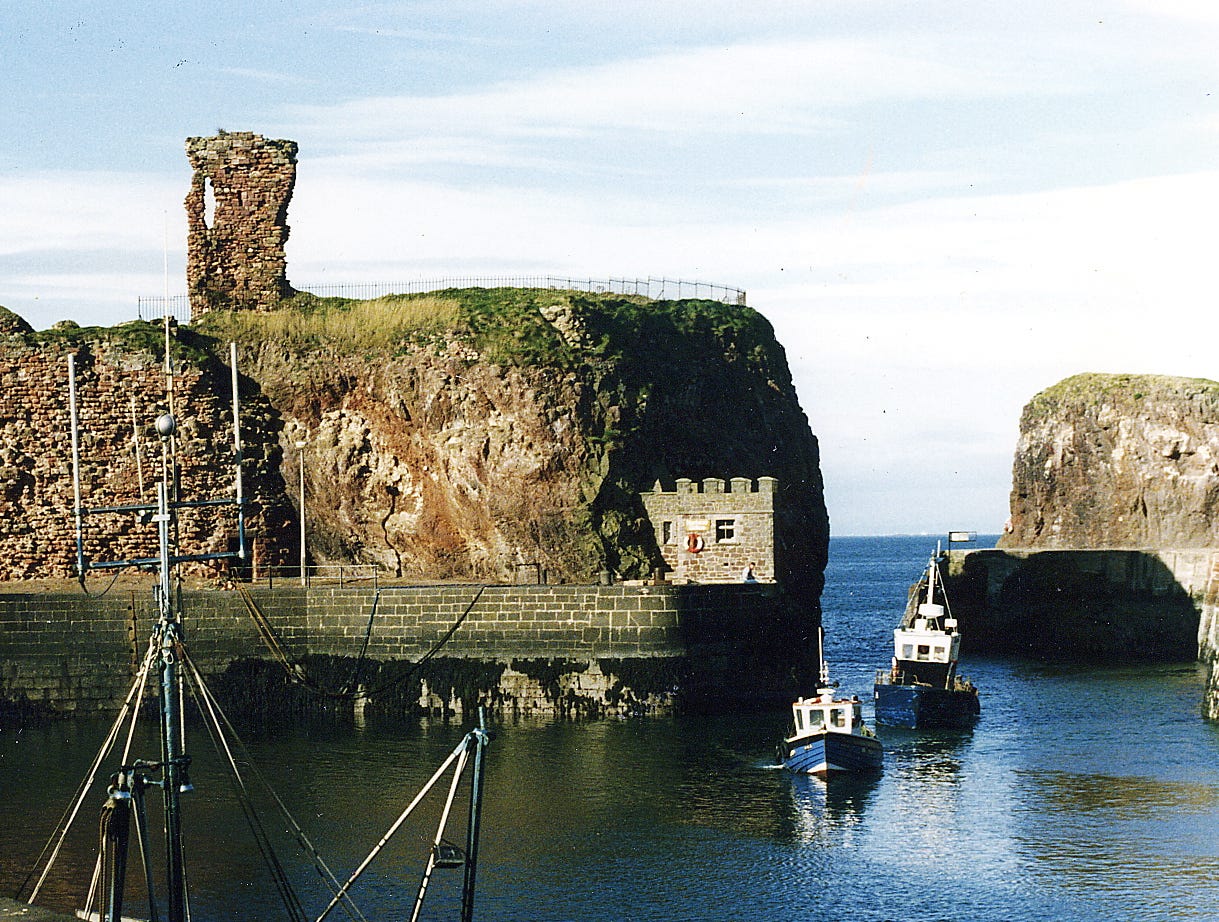
Finally Edward reached the castle of Dunbar, where the Earl of Patrick received him and his men. He was able to arrange a ship to take Edward and some of his household knights to Bamburgh (and from thence to Berwick) but the rest of Edward’s troop, numbering nearly 500 men, had to return south over land. Not that the Earl of Patrick was particularly a strong supporter of the king of England. After his liege lord and his men left, Patrick immediately defected to Bruce.
THE FATE OF THE EARL OF HEREFORD
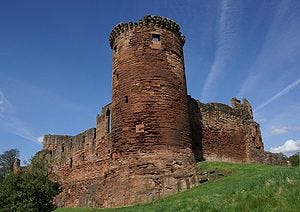
The Earl of Hereford, Humphrey de Bohun, also fled the battlefield taking what was left of the vanguard with him. He managed to reach Bothwell Castle on the Clyde. Walter FitzGilbert, the constable, offered to shelter them. They must have thought that their ordeal was finally over, but they were to be dismayed when FitzGilbert took them all prisoner: the constable had changed allegiance to Bruce. In this way, several valuable English lords were captured for ransom, the most important being, of course, the Earl of Hereford himself. But apart from him, other notable names included: Robert de Umfraville, Earl of Angus; Ingram de Umfraville; John de Segrave; Maurice de Berkeley, Anthony de Lucy. The Earl of Hereford was eventually exchanged for Bruce’s queen, sister, daughter and the old Bishop of Glasgow, Robert Wishart. Most of the others had to raise ransoms to get themselves released.
Not all of Bruce’s prisoners were treated the same however. The old veteran knight, Marmaduke Thweng (great name, eh?), had surrendered himself to Bruce after the battle. In recognition of this, and of the older man’s years of service, Bruce allowed him to go free without a penny being paid. It was the same for Ralph de Monthermer, Gilbert de Clare’s stepfather, confirming that there may have been some truth in the rumours he had once saved Bruce’s life by sending him a coded warning at Edward I’s court.
Bruce also acted with true chivalric courtesy towards some of the dead. He was genuinely sad about the Earl of Gloucester’s death: de Clare was a second cousin and his foolhardy bravery had earned Bruce’s respect. He released the Earl’s body without a ransom and sent it back to England, preserved in pickle and with an escort. Clifford’s body was also given back to his family without any demands being made.
Bruce’s ‘hearts and minds’ campaign did not stretch to everyone though. Most of those killed at Bannockburn were either thrown into the pells or else buried in mass graves which have never been found.
THE FATE OF THE EARL OF PEMBROKE
It is recorded by several chronicers that Aymer de Valence, Earl of Pembroke, finally escaped from the battle unarmed and barefoot. The most likely scenario of what happened to him is that he was in charge of fighting a rearguard action to give Edward more time to get away. Somehow he lived and avoided capture and probably made his way back to England in the company of some of his Welsh archers.
In conclusion, the Battle of Bannockburn was a disastrous defeat for Edward II. There were many reasons why the English army failed so badly:
Edward underestimated Bruce and assumed that he would not fight them in the open.
There was too much infighting amongst the commanders of the English forces, with individual egos being more important than working as a cohesive force.
Edward’s inability to control the stronger personalities among his commanders
Not turning back when Stirling Castle was sighted, i.e. relieved.
Exhaustion and illness among the troops after a long, hard march.
Low morale among the English troops.
A poorly-picked place to camp and spend the night on the 23rd, with no strategy in case of a full-on attack.
The defection of Sir Alexander Seton, giving Bruce essential intelligence into the mood of the English army.
A failure to have a strategy to use against the schiltrons - after all their use in battle by the Scots was not exactly unknown - the Earl of Pembroke had faced them before at Loudon Hill, and de Clifford and de Beaumont encountered them the day before.
Edward’s reputation was now in shreds, and the defeat did nothing for his popularity, having lost so many lives and spent so much money on a venture that, in the end gained him nothing. He even forfeited Stirling Castle in the end as, after the battle, de Mowbray swapped sides and handed it to Bruce (who then slighted it to prevent it falling back into English hands). Of course, the debacle has caused many accusations to be thrown Edward’s way by historians - such as being a disastrous leader in battle and a coward. While his behaviour at Bannockburn in terms of controlling his commanders and sustaining the morale of his troops certainly left a lot to be desired, his courage was never in doubt. He had to be dragged from the field, and even then fought fiercely when beset by the enemy.
Humiliated and demoralised, Edward and his men finally all returned home. But what was probably to prove worse for him in the long term was that the Earl of Gloucester’s death now paved the way for Hugh Despenser the Younger to rise to power. That was a disaster of a completely different magnitude.